I’ve worked in marketing for more than 30 years. Don’t worry, this isn’t a post about marketing. A good part of the actual job of marketing is managing other people’s expectations: your bosses, being measured about what you can achieve, while still painting a vision of much better; your customers, again balancing the lofty claims you’d love to make or the demands they throw at you against not promising the world; and in communications, why promise world peace or personal enlightenment if you’re selling orange juice?
Anyway, this has been brought home to me in a far more important way in these past 10 days, as I emerged, shell-shocked and blank, from what I though would be a routine outpatient appointment at the Eye Clinic.
I was first diagnosed with glaucoma in 2016, when I was apparently about 15-20 years younger than the usual first presentation. No matter, the mean period of progression towards serious sight impairment is apparently also 15-20 years. And in most of my 14 appointments over the past 7 years, my introcular pressures have been ‘good’, ‘fine’, ‘pleasing’, because they’re well within the ‘normal’ range and seemingly mostly stable, controlled and supported by me using eye drops every day.
My healthy right eye, April 2024 (93% VFI)
No alarms and no surprises…? It was not a shock when I rested my chin on the stand and the Visual Fields test started. This was the test that first alerted my optician to the problem. The optic nerve in my left eye is permanently damaged, which affects my peripheral vision. I’m fortunate that my right eye is unaffected, and has remained resiliently so despite the issues in my left eye. That, plus the remarkable ability of the human brain to compensate, means that I’ve barely noticed any change in my vision at all. I’m mainly reminded of it when I peer at the orange light in the domed VF testing machine, and wait for the pinpricks of light to appear around that centre, It’s no surprise that I see far fewer than with my right eye, but even by my standards this test seemed ‘disappointing’. There was a l-o-n-g wait from the time the nurse said “OK, we’re starting now” and the machine whirred into life until I finally squeezed the clicker, partly with relief, more with resignation.
But even then I didn’t expect what was coming.
this left eye is very serious now… really limited vision… there is a surgery, but honestly that maynot resolve the problem… but if we don’t do the surgery you will certainly lose the sight in that eye in 5 years…
Virtually every conversation I’ve had with consultants at my appointments has concentrated, almost entirely, on the pressures inside my eyes. And while they have sometimes increased, they’ve always then decreased, and always within the range that is usually labelled as ‘normal’, with descriptions like
…pressures are very well-controlled (August 2023) …glad to see that Chris’ introcular pressures are slightly lower than the last time (March 2023) etc etc
The vision was barely ever mentioned, which left me with the feeling that if the pressures were OK and stable, that meant the vision was too. After all, I’d been told the degradation could take 15-20 years.
My damaged left eye when I was diagnosed, June 2016 (43% VFI)
I’ll say here that I’m currently seeking explanations from the Ophthalmology team about the advice and information I’ve received. After the shock I requested to see the details of my tests: I’ve had 11 VFI tests and 14 eye pressure checks since 2016, but never seen the details. And I do have questions. When I look at the information and the trends in the data I’m keen to understand why something wasn’t said 3 years ago about the declining VF scores for my left eye.
But that’s just for me. Nothing I can say or they can say, or treatments, or surgery will repair the damage. I will have surgery in a few weeks to create better drainage in my eye and reduce the pressures further. This may cause blurry vision, and it may not even stop or even slow down the decline, which might be caused by something else, apparently.
Look on the bright side… I do have a bright side: when I close my left eye, the brightness and range of vision compared to when I close my right eye is notable. Right now it’s like the ‘vignette’ filter on an Instagram picture, where there is a slight shade around the outer edges of the frame. It’s not especially dark or very significant, but I know it’s there, and I know it’s going to get worse. And soon my right eye and brain will only be able to compensate so far.
Living with monocular vision (only one eye) isn’t a terminal thing. It’s nowhere near as difficult or painful or life-limiting than many, many conditions. But in the days since that meeting, I’ve spiralled through all the stages of loss, sometimes in a single hour.
I’m grieving for something that hasn’t happened, but there is a tangible sign of its oncoming inevitability and indeed proximity. I’ve stopped playing my French Horn, as it is something that is associated with higher pressures in the eye. Part of me wants to argue that my pressures have been “fine”, “well-controlled” and “stable” for most of the last 8 years. And I’ve played all that time because I thought it was OK, because noone told me to stop. I don’t know if or when it might be OK for me to start again.
I could’ve done better…? Because I’m programmed this way, I’m now angsty about what more I could have done. I examine politicians’ statements on the news for every hint of spin, I question my clients’ briefs to get to the root causes of things, and yet when my consultant seemingly skips over some issues in favour of others, I don’t pay attention to what they’re not saying. I heard what I wanted to hear, that it was all right. Well it’s not all right now, and it wasn’t really at least a year or two ago.
My left eye, April 2024, 23% VFI
And so I’m facing my own frailty, that in a few years I might well be blind in one eye. I’m 55, which I suppose is objectively ‘getting on’, but then this morning I cycled around the local lanes for two hours and did more than 50km, which isn’t too shabby. Nevertheless, by this age my Father had had a heart attack and bypass surgery, and my Mother had breast cancer. Both of those are, I Reckon, more significant than my own issues. Yet every time I get close to accepting this, starting to deal with it, I then reject that mindset. Why should I have to f***ing deal with it? And then I feel guilty, and then paralysed, and then and then and then I go around and back to the start and around again.
So I’m keeping busy, and am compiling a list of things I really want to do where binocular vision might be more important, like hiking the ridges and peaks around Buttermere, and the Langdale Pikes. If anyone fancies that I’d love some company. And I know a couple of amazing places to stay up there.
Most of the films I watch aren’t new releases; probably 3/4 are at least a year old by the time I get around to watching them. Quite a few I didn’t know existed until a streaming service alogorithm fed me a trailer or a teaser on every menu page possible. So while my favourite new releases of 2023 are here, this post is a longer list (but shorter commentary) of the best films I saw for the first time in the last 12 months. I review virtually everything I see on Letterboxd so you can always check in on things there. Again, these aren’t in any particular order, apart from a few at the end that sort of rise above the rest…
Is this on? I mentioned that 2023 hadn’t produced a great deal of great documentaries, at least no many that I had seen, but last year I saw many long-form non-fiction stories brought tolife in thrilling fashion, and three of them were about musicians and music.
The Beatles: Get Back is a remarkable achievement in editing, documenting several weeks of recording sessions by probably the greatest group ever as they stumbled and soared towards the end of their short career as a band. But by the end 7 hours was barely enough – the talent in the room is astonishing and it’s truly a rollercoaster ride, capped by a joyous and subversive rooftop concert that has inspired countless copies.
Summer of Soul (…or, when the revolution could not be televised) is another triumph of editing and reconstruction, this time by Questlove, of 6 weekend concerts that took place in Harlem during the Summer of 1969, when America and the worlds’ eyes turned to The Moon Landings or to Woodstock. These concerts were filmed but no TV station wanted to use the footage, so now the hugely significant cultural event is restored, and it is essential. Condensed into just 2 hours there is no filler here, it’s all breathtakingly brilliant performances and wonderful 1st-person interviews with both performers and audience which brought tears to my eyes more than once.
Moonage Daydream is a feast of images and sounds, more(!) astonishing editing and some of the greatest live performances ever, capturing the career and characters of David Bowie. As with the other two, this is elevated by its subject.
A couple of films about couples
Sam and Tusker and Charlie and Nicole are couples whose relationship may be in trouble, but for very different reasons. Supernova places Colin Firth and Stanley Tucci in the most beautiful parts of the Lake District and dares you not to weep. I failed dismally. Noah Baumbach’s masterful Marriage Story starts with opening monologues to prove that Charlie & Nicole (perfectly played by Adam Driver and Scarlett Johansson) do love and can make each other better. But then we see how it can be picked apart and weaponised by an industrial-divorce-complex and there is the greatest, worst, most horrific, moving, crushing marital argument I’ve seen on film. Both of these more than meet the old definition of a great film; “three great scenes,no bad ones”.
Ken Burns’ epic documentary The U.S. and The Holocaust is vital viewing, to show how at least some of Hitler’s anti-semitic policies were ‘inspired’ or at least emboldened by anti-immigrant rhetoric from countries around the world, including the UK and USA. And then we see, in painful, shattering detail, the result of those policies. planned and executed by human beings against human beings. And then we see more contemporary montages and clips that remind us why we must remember and learn from history, lest we are doomed to repeat it.
For a complete change of tone and scale, a wonderful heart-lifting antidote to the world is Marcel the Shell with shoes on, a unique animated film that’s not much more than an hour long, about a shell, named Marcel, who wears shoes, trying to find the rest of his family, scattered and lost after an unnamed tragedy. Trust me, if you don’t get a warm feeling after this I can’t help you.
He doesn’t just wear shoes…
When the world of work doesn’t work… After that very brief interlude of happiness, apologies that it doesn’t get much better for a while… The Assistant is a savage, uncomfortable day in the life of a PA to someone like Harvey Weinstein. Set almost entirely in a bleak, desaturated office lit by antiseptic strip lights and filled with people doing what they have to to survive, even if it sucks at their soul.
Compared to that, at least Sorry to Bother You is darkly funny: Lakeith Stanfield discovers his ‘white voice’ as he tries to become a power-caller in a surreal parallel universe that’s achingly close to reality, until it’s not (the less you know, the better).
But then there’s I, Daniel Blake, where the title character, wonderfully played by Dave Johns, has injured himself at work (he’s a carpenter) and needs state welfare support while he recovers and tries to find new work. This is a righteous burst of barely-controlled frustration and anger from veteran director Ken Loach, inspired by and compiled from real events and first-person testimonies. The State is inhuman and dehumanising to both its agents and its citizens. Its language is like something out of a misanthropic AI, removing and preventing even a smudge of agency or empathy. It’s grim, but important.
Athena contains perhaps the most amazing single sequence in any film I saw in 2023, or perhaps for quite a few years. In an unbroken 12-minute shot we’re taken from a police press conference about a child from the banlieues estates on the edge of Paris being killed, to a mob invasion of the police station and a jaw-dropping chase back towards and through the estates and tower blocks. It’s immersive, visceral and physically wounding film-making, which the rest of the film almost lives up to.
Trying to fit in…? Calm with Horses had a different title for its US release – The Shadow of Violence – and for once I feel that may do a better job of reflecting the tone of the film, its story and characters. Cosmo Jarvis is is both terrifying and heartbreaking as the damaged, dangerous, abused attack hound of the savage criminal Devers family, who is trying do more for his autistic son, but can’t seem to escape the shadows that engulf him.
Mogul Mowgli proves again that Riz Ahmed is one of the best UK actors around, as he plays a deeply flawed character on his way up and then back down again, spending just 82 minutes exploring Big, BIG Themes.
I read the Dune sci-fi novels when I was a teenager, but never watched the ‘problematic’ David Lynch film from the 1980s. The new version wisely splits the vast first book into two films, whose second part I’m eagerly awaiting next year. This is EPIC in almost every way with a terrific ambition that it pretty much delivers in every department. The pacing is slow, but wholly appropriate to an 800 page source. There are properly outstanding moments and sequences, and this is almost certainly Hans Zimmer’s best score in years.
Speaking of David Lynch, I filled a blind-spot in 2023 by finally watching Mulholland Drive. I have a mixed relationship with his films, but this one is often cited as a masterpiece. After 45 minutes I was confused, disappointed, resigned to the fact that I just don’t get David Lynch. And then there are scenes which feel like they’re from a completely different film, with different characters. And then it really gets going. I definitely didn’t get it, so I read a couple of ‘explainers’ and then it was all I could think about for days. It’s about dreams and memories and fantasies, overlapping and sometimes all at once.
I wrote a long time ago about Cate Blanchett, and perhaps this year I saw her crowning performance, as Lydia TAR. Lydia Tár is a maestro of international classical music, and a monster. We’re only shown glimpses of the consequences of her actions, the wreckage tossed in her wake. Students, classmates of her daughter, colleagues, musicians, all are sacrificed at her altar. But the artifice she has constructed around her self starts to dissemble and ghosts emerge from the cracks.
Two of the best films I’ve seen in ages are both directed by the same person, Celine Sciamma. Telling intimate dramas in remote locations almost 200 years apart, they are beautiful and wonderful and heartbreaking all at once.
Petite Maman tells the story of Nelly, a young girl whose beloved Grandmother has just died, and her mother Marion, but in ways I did not expect at the start. The conceit of this film is both stunning in its concept and execution, and in just 82 minutes it’s a rich meditation on resilience, grief, and love,
And then there’s Portrait of a Lady on Fire, of which I knew little except the near-universal acclaim it has received. Set in 19th Century Brittany, it tells the story of Marianne, a young artist commissioned to paint the portrait of a bride-to-be Heloise at her remote familial home.
All I can say is believe the hype: this is wonderful. I ended up watching it in three parts, and to be honest I’m not sure I could watch in a single sitting: it might be overwhelming, in a way like nothing else since Grave of the Fireflies.
Almost from the start I was gasping at the simple beauty of it and the perfect framing of every shot. The Brittany surf is intense, properly roaring and intensely bright in contrast to the muted tones and silence of the house. The depiction of the artist’s process and the construction of an image from a blank canvas is gorgeously rendered, and everything looks beautiful. But even more than this, the script is perfection, about observing and being observed, about regretting and forgetting.
For a long time, a way back when, I used to think that Bob Hoskins’ final scene in The Long Good Friday was as good an ending as I could think of. Then it was Glenn Close in Dangerous Liaisons. More recently, Charlotte Rampling in 45 Years. But the final scenes here are another level. If I see a more moving film than this any time soon, if ever, I will be absolutely astonished.
Well, this has been quite the year, but more of that later. If nothing else, I like to keep the annual tradition of waxing sort-of-lyrically about the best films I’ve seen each year, and as per the new normal, splitting this into two parts; to follow, hopefully very soon, a selection of films that were first-time watches for me even though they weren’t new releases and, here, great films that I did manage to see around the time of their release in 2023. Of these, I saw around half in the cinema.
According to my Letterboxd Diary I’ve seen 208 films in 2023, of which 148 were new to me, and 32 were released in 2023. of which I’ve picked out 12 here for particular recommendation.
Get comfortable… There is a reasonable debate in the cine-ternet that films are getting longer, but not in a good way. I tend to agree that (especially) the effects-laden spectacles of various cinematic universese hit their point of diminishing returns more than a few years ago, and I find myself increasingly drawn to films under 2 hours, ideally closer to 90 minutes. However, 2023 came up with more than a couple of exceptions to the rule.
A contender for Face of The Year
All Quiet on the Western Front leans heavily on previous great war films like Saving Private Ryan, Gallipoli, The Thin Red Line and 1917 and the glacial luxury of the generals (are these croissants quite fresh?) feel a lot like Paths of Glory, but all of this is meant as very high praise. It starts with an outstanding prologue sequence about a coat that is truly chilling, and then the battles and hospitals are grimly visceral experiences. The tank attack is amazing, the horrific drawn-out fight and death in a bomb crater, and the final assault is devastating for its inevitable effects and timing.
In an entirely different way, the epic film RRR was my first Indian Cinema blockbuster, and I doubt it will be either my last, or if there will be many better. From the first moments it’s obviously not quite what Western films are, but I gave myself over to it, and my world is a better place for doing so, because it’s f**king amazing. The style, the sound, soundtrack, the Greek-Indian chorus that comments on the action (“who knows if this friendship will end in violence?”), the stunts, the songs, the dancing…
A Bromance for the ages…
“can you find the wolves in this picture?”
Martin Scorsese in well into his 80s, but seemingly not lacking energy or ambition. Killers of the Flower Moon is over 200 minutes long, and was the first film I saw with an interval since Dances with Wolves (in France, in 1991). His thesis is that it is possible to commit genocide one person, one family at a time, and this is what happened to the Osage Nation. The Osage people are at the heart of this story from the start, and at the heart of that community and this film is Molly Burkhart, played with breathtaking poise, grace, dignity and strength by Lily Gladstone, who surely deserves All The Awards attention. And accompanying every excellent frame is the wonderful score by the late Robbie Robertson: it throbs like a heartbeat, rolls and slides, murmurs and jangles. Sometimes it’s comforting, more often it’s only-slightly unsettling, as if it whispers of a future sadness. And it has an epilogue that truly comes from nowhere with a cameo performance for all time.
Another contender for Face of The Year
Christopher Nolan’s Tenet was a very noisy disappointment which left me cold (and I confirmed this a few months ago with a rewatch). However, Oppenheimer is right up there with the best films of the last few years for me, and with his wonderful Dunkirk. Cillian Murphy (a third contender for Face of The Year). For a long time I felt I was watching a perfect film. The stakes are high, the craft is impeccable, the performances are universally great, especially Cillian Murphy, who is mesmerising, but Robert Downey Jr and Emily Blunt are also excellent. The score is outstanding (in a very different way to KOTFM) and the visions of quantum reactions are beautiful.
Lastly in the ‘epic’ category for 2023, Taylor Swift: The Eras Tour was compulsary for Eleanor and I, as I have become a bona fide Swiftie Dad through her carefully curated education during our school run commutes. and am a genuine fan. My first thought as the film progressed was that Taylor Swift and Beyoncé seem to be light years ahead of any male solo artists I can think of or care about. This is an amazing show, masterfully constructed, technically brilliant, full of absolute bangers and much more besides. I found myself disappointed it wasn’t longer, knowing thatsongs like Cardigan and Wildest Dreams were cut…
I’m intrigued by the guileless charm and joy of TS, and at the same time the amazing deliberate precision planning of every detail. Maybe she is a f***ing Mastermind. Because the show pulls off several amazing tricks. It starts strong but somehow nearly every section seems to build on the ones before. For someone who has worked so hard her whole life at being a singer & musician and writer, she has no right at all to be so good at everything else.
Normal Length films… and a good year for comedy In complete contrast to the polished leviathan of Ms Swift’s Stadium tour, Rye Lane is an outstanding debut feature from Raine Allen-Miller, perhaps rough around the edges, but only 82 minutes long. It’s an antidote to most RomComs, because it does both parts wonderfully and more besides. Full of lovely creative touches & flourishes, and a cameo to die for, it also has the best use of a scooter as a romantic ‘vehicle’ since Amélie.
In a not-bad year for comedies, at least in my viewing, They Cloned Tyrone is another feature debut, for Juel Taylor, with which I had an absolute blast. In parallel universe which seems to mix different time periods (like TV’s Sex Education but more layered). Old cars, adverts, sexist attitudes and (amazingly) The Nancy Drew Mysteries clash with moible phones, social media and self-care tropes. With hilarious effects. The script is sharp and often savage; the performances are across-the-board excellent, and the story is full of surprises. Immediate vibes of 70s Blaxploitation give way to weirder, unsettling things like They Live, Get Out, Us and Sorry to Bother You.
Adam Driver may be one of the busiest actors going, and with good reason, although sometimes he’s the best thing in a ‘decent’ film. White Noise is not like that, because while he is very good, so is pretty much everything and everyone else. This is good fun, something not to think too hard about. And it has Greta Gerwig, which is also always a good thing. And a final scene that is right up there with the end of Paddington 2, and indeed one of the films still to come here…
Not so many great documentaries, but this one is worth it I’m not sure what it says about the state of streaming services and their documentaries, but the only 2023 doc on my list is The Deepest Breath. I came to this pretty cold, but assumed it would be similar to the climbing films I often like; breathtaking bravery, extreme activity, reconstructions of tragedy & triumph that can’t easily be shot live and astonishing to look at. I was right but not in the way I thought. The first half is a slow but important origin story for two people who steadily move towards each other’s orbits. Halfway through there is a week of a competition that changes both their lives. And from there the documentary part of this film almost takes a back step to the constructed storytelling, perhaps to Something Bad that we’ve sensed is coming. When it does, the ‘reveal’ is at once wonderfully realised, breathtaking and heartbreaking.
Less Brideshead, more Alien…? The most recent watch on this list is the divisive Saltburn, written and directed by Emerald Fenell, whose first film Promising Young Woman was also divisive, tackling similar issues to Women Talking but much more as a personal scream. Saltburn is a grotesque, deliberately exaggerated fantasy, a grim fairy tale of a cuckoo in the nest. Instead of idolising and basking in the fragile souls and insanely inherited wealth of young aristocrats like previous generations of English writers, she picks them apart as vapid and childish. And is terrifically funny along the way. And our ‘guide’ in this is Oliver, the everyman we can side with because we’re more like him than them. Until, and the signs start early, we’re not.
The cast are outstanding, and it looks amazing. Some have criticised it for being deliberately shocking and less clever than it pretends to be, but I don’t think it’s trying to be clever. It’s upending the Downton Abbey’s of British TV and Cinema History and in some pretty nasty ways. I Reckon the less you know the better, but be careful who you watch this with.
Two films, similar themes, not the same at all… Women Talking is not about an outlier community from another time, but it is set in a religious Mennonite community who live in a world apart, without technologies, their routines aligned with natural daylight. But the themes of gender inequality, abuse and complicity are fierce and relevant.
And perhaps my favourite (possibly not ‘best’) film of 2023 is just edged by Greta Gerwig’s unstoppable Barbie. This was not a sentence I thought I would write at the start of 2023. But I have seen this hilarious and important film three times at the cinema, which I’m not sure I can say about any other film.
One of the reasons I rewatched is that it’s so, so funny, and the jokes often come so fast it’s hard to keep up, or there are fantastic visual details all around. The songs are truly great and the construction of BarbieWorld is terrific. And if there’s any justice Ryan Gosling will win all the awards. But will they matter if Barbie doesn’t notice him?
HonourableMentions, TV… Because these are sooooo good, I couldn’t let this enormously overlong piece go without mentioning The Bear, which is everything you’ve heard it is. Overwhelming and intense, unlikeable characters making bad decisions and often hurting people as they do, it’s also genuine and breathtaking and moving and uplifting. And it has amazing food, a brilliant, brilliant cast and a collection of guest stars to die for. And Forks in Season 2 is perhaps my favourite epsiode of TV ever.
And, the final season of The Crown. I know many people, most notably for me my normal news site of choice, The Guardian, have been very sniffy about this, like Prince Phillip thinking about journalists. And it’s true the proximity of events and the familiarity of the characters does change the series quite a lot. But I Reckon they did a terrific job, and the final episodes are fantastic, especially ep.8, with just perfect acting from Imelda Staunton and Lesley Manville, and the final sequences that bring the focus back to Queen Elizabeth (all of them).
I wrote recently about the dangers of design, thinking, marketing (anything, really) converging towards a homogeneity. One-size-fits-all is wrong on so many levels and I Reckon it always has been. But various forces with their own vested interests have promoted it as a ‘best’ solution, because you can’t please all the people all of the time.
Maybe not, but as countless studies have found, if you design something for the ‘average’, you’re actually designing for no-one.
For a start, almost no-one is actually ‘average’ on more than a couple of dimensions or attributes. And to follow up, averages change; which is why I really, really dislike going to a certain theatre in Bristol, because its aged seats seem to have been designed for an audience of 12 year-olds.
For generations, most workers have spent more of their waking hours at their place of work than at home. And yet these workplaces, from Victorian factories to contemporary call-centres and everything in between, were often designed with little thought to the needs of the workers beyond that of productive efficiency, then operational functions and only later things like hygiene and safety.
A step-change?
It’s true that quite a lot has changed in the last few years, largely precipitated by the Pandemic, with hybrid working and/or greater flexibility increasingly common for previously office-based jobs. In parallel, initiatives to improve equality and equity of treatment in recruitment, management and pay across genders, race and other dimensions are making long-overdue progress.
Full disclosure: since pivoting to be a freelancer after the first 2020 Lockdowns, I’ve spent probably 90% of the last three years working from home, so I’m not up-to-date with if or how offices and workplaces have transformed since the Pandemic, to adapt to new ways of working, variable numbers of people in the building on any given day (etc). Nevertheless, I was keenly aware that, back in 2020, most offices I had ever worked in or visited were not designed for a diverse range of preferences or needs. By far the norm in my experience were large open-plan spaces with rows or clusters of workspaces (desks), sometimes with some kind of dividers or screens, and usually with break-out tables or individual work-pods, and varying sizes of meeting rooms.
These can be great for knowing where everyone is, coordinating the logistics of electrical and telephone cabling, helping the space to feel light and open, fostering teamwork by having everyone in view, but there are significant drawbacks, which I’m sure resonate with most people who’ve ever worked in such an environment.
It’s noisy, mostly a low-level background chatter, but there are always sounds coming from somewhere; people who like to work with music, a team meeting at one of the breakout tables, people chatting at someone’s desk, the whirr of a printer or photocopier, people walking about, asking “have you seen ____?”. Sound carries around the open spaces, and this doesn’t work for everyone or every type of work. It’s an environment that favours, facilitates and encourages extraverts, those prepared to be public and (however unwittingly) put their needs before anyone else. It’s not helpful for deep, concentrated work, as the background distractions are frequently punctuated by ‘people interruptions’. Depending on your source, somewhere between 30-50% of people prefer introversion, which suggests that the standard open-plan format needs greater flexibility to accommodate their needs, if not all the time, then at least some of the time.
Our eldest child (now at university) is autistic, but I know they would find a busy, open office, especially with multiple and ever-changing sources of noise and distraction, almost impossible to work in – which might be a reflection of why barely 1 in 5 people with autism are in paid employment: the world of work has not considered them. It’s surely a reflection of these varying preferences that so many people are delighted they can now work in a hybrid fashion, with days at home each week, free from so many immediate distractions and irritations.
The kerb-cutter effect can work for everyone Offices (like factories before them) were designed by companies for the company, to make it easier to set up the equipment their people need, to ensure everyone has a dedicated space, to know where everyone is. Companies often hired people using psychological testing to get the right ‘fit for our culture’, but that often meant hiring people like us, like the founder, extraverts who enjoy the same things the confident leadership team do. But given everything we now have at our disposal in terms of technology and communications, and what we know about mental health, productivity and the diversity of personal work preferences, let alone neurodiversity, perhaps we should be hiring more the right people for the job, recognising that when we cater for diverse needs, everyone gains.
It’s not just ‘niche’ minorities with visible or invisible medical conditions, it’s recognising that people are different, and as I bang on to my marketing clients whenever it’s relevant, if you know that people are different, and you can treat them differently in ways that matter to them and can make a significant or meaningful difference, why wouldn’t you do that? They will recognise what you’ve done, and often thank you and reward you for doing it. It’s a positive-sum game.
“Working” from home… It used to be a trait of ‘presentee-ism’ culture to make a swift and snide crack about people who occasionally wanted to work from home (or indeed just left early for once). Being in the office was productive and meaningful, anything else was less so. I’d always believed and hoped that if my bosses treated and trusted us as professional adults, my colleagues and I wouldn’t take the pi*s. We would get the work done, and they wouldn’t always be peering over our shoulders.
The past few years have, I hope, vindicated my hopes, in that more companies have realised the benefits to both company and staff of a more flexible working culture that enables people to better align their working and personal commitments, to have a hybrid working environment that enables everyone to give of their best more often.
I’ve only been into an office of any kind for work twice in the past year, and each time only for a day. Much as I love my freelance-contracting role, and have had wonderful experiences doing work of which I am really proud, I do hope that more of my work in the coming months can be actually in rooms with people. I Reckon it’s where I do my best work, being able to share and build ideas quickly and immediately, and yes, sometimes in those open-plan environments that can be problematic for some (many) people.
So after a period of very little work (May 2023 will be my first month since August 2020 in which I have not submitted an invoice to a client), that’s what I’m looking for; the chance to work with people both virtually and in-person, with time for me to do better, deep work without distraction, and the opportunities to make it even better through face-to-face conversation. If anyone has any ideas or openings, please let me know!
And, as I freely admit, I’m out of the loop about how working practices and office spaces have changed in the last couple of years, so I’d love to hear from anyone about this – please leave a comment your (hopefully positive) experiences!
5 years ago I wrote a post about how the world of 15 years ago, the age of indifference and ‘meh’ had been replaced by outrage, fury and, well, more outrage. I referred to a review of journalist Jon Ronson’s book about social media shaming, which discussed
…a scuttling crowd of people who want nothing more in life than to be offended. Offence, for this lot, is not a straightforward emotional response, instinctive and heartfelt. It’s a choice, something they actively seek.
Rachel Cooke, The Observer, 15th March 2015
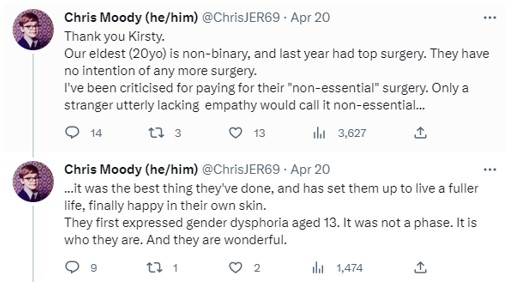
Well, dear reader, this past weekend I encountered part of the scuttling crowd on Twitter, and it wasn’t pretty. The algorithm decided to show me a post from Kirstie Allsopp in which I thought she was actually trying to Do The Right Thing rather than shouting her mouth off. There’s quite a bit of nuance here, perhaps the sort that could get her abused by both sides, but I was on board. She wants to elevate the conversation away from different groups attacking each other.
So like a naive liberal lunatic I chipped in. Thinking of David Mitchell’s line about everyone stepping up to make a difference because “what is an ocean if not a multitude of drops?”. I was trying to illustrate the point that many trans- people are just trying to live their life, they want to be happy, they don’t want to hurt anyone. I deliberately made it only about our family to try an humanise it, but also to not claim I’m speaking universally, although I accept that “the phrase”utterly lacking empathy” probably didn’t help…
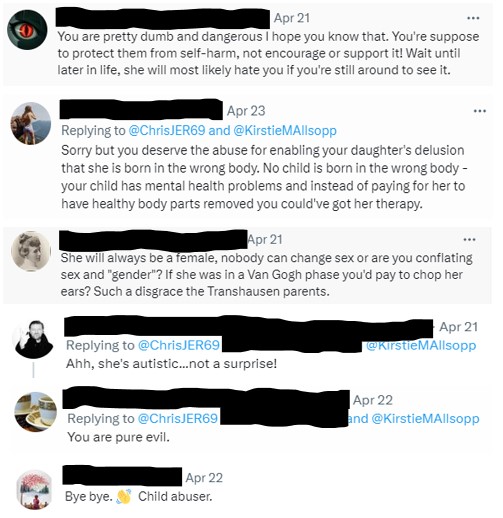
Anyway, I posted that on Thursday evening, which led to an interesting set of notifications by Friday morning, and indeed over the weekend. Here’s a pretty representative sample…
It was a relatively small group who responded, but they were tenacious. A couple were more ‘reasonable’ in that they did agree to disagree with our choices, and had the grace to wish us well, and hoped we would all be OK (even though they kind of doubted it). But the majority were not like that. I’d characterise them in three ways.
They’re right and everyone else is wrong. They truly live in a binary world, and deny the entire concept that a person could be ‘Trans’. Every aspect of Trans is false, dangerous, a scam, a lie, evil. They’re not really Trans-phobic, because in their world it is simply impossible that Trans people can exist. Any so-called science that affirms, accepts or even acknowledges it is wrong and bogus. Their feeds and posts often include the same images and links as ‘evidence’ but often this is a very ‘particular ‘generous’ interpretation of that term.
For instance, the book “Time to Think” by Hannah Barnes is a damning indictment of institutional and clinical failure at GIDS and The Tavistock & Portman Trust, documenting at best problematic but more likely unethical and damaging practices on children, driven at least partly by an agenda that excluded alternative approaches. This is now used by the people who responded to my story as ‘evidence’ that Trans- is a myth, and anyone in the medical establishment who disagrees is a danger to children.
They seek out the things they abhor. I have narrowed my Twitter Universe over time to professional cycling, film and marketing strategy types. I want to read and post positively, sharing ideas and experiences – especially about topics I love with other people who share that passion.
The Trans-deniers I encountered seem to actively immerse themselves in stories and news that will offend and outrage them, exactly as Rachel Cooke described. They’re not looking for uplift or inspiration, but validation that they must continue to be vigilant and angry. They rarely seem to post original opinions, almost entirely retweeting or replying to what other people have said. They only discovered me because they follow Kirstie Allsopp, whom they mostly despise. It’s an endless cycle of outrage, shock, anger and attack. It must be exhausting to exist in such a constant heightened state of almost existential fear and threat created by the very posts with which they choose to fill their news feeds.
Anyone who disagrees becomes an enemy target. Anything short of complete rejection would imply an acceptance of the concept that some people can be Trans-, so everything I said was challenged, ridiculed and attacked. Every response referred to ‘she’ when I’d clearly stated ‘they’. They were absolutely and utterly convinced they knew that I was wrong, deluded, cruel, and dangerous. There was no way anything I said could be true, and I needed to be shot down and shut up.
I know that these insults are far less serious than many people face every day on social media platforms. But even these ‘mild’ jibes would be unacceptable in our schools or workplaces; the offenders would be taken to one side and reminded about values, mutual respect and courtesy. But Twitter operates in a parallel universe where that social contract does not apply. I did report a couple of the more direct messages to Twitter, but apparently they didn’t break any of their codes of conduct. If I don’t like the people calling me ‘pure evil’ or ‘child abuser’, I can block them, while they can carry on attacking any number of other people in the same way.
Let’s get the Hell out of Dodge… And so I have shut down my Twitter account for good. I have no intention or desire to offer Elon Musk and his platform any of my time or energy when it actively condones that sort of behaviour. I Reckon Twitter is worse than other platforms, because while I can choose my friends and whom I follow, it’s much easier and faster to see a whole lot more content on Twitter than I’d like. It’s very hard to control what you see and don’t see.
I will lose a lot; just in the few days since the weekend and deciding to close my account, I’ve had great interactions and chat about cycling and films, but I know I will gain a lot more; time, for one thing. All that cycling bantz takes time, especially when there are races on. I’ll also gain calm. I’ll not miss the sinking feeling of resignation anytime I see J K Rowling or Glinner or Eddie Izzard trending, knowing what’s behind that link; a cess-pool of rage and hyperbole.
I’m not judging people who want to keep using Twitter for the ‘right’ reasons. And I know that most / all(?) social media platforms have their problems, but this to me is just about how we treat each other. Twitter doesn’t give the first sh*t about how people behave, in fact I Reckon it revels in it. It knows that offence provokes outrage, that negative news evokes stronger responses than being nice.
I like people being nice. I believe in nice.
I want to leave those bigots behind, because they can deny our non-binary child and millions like them with all their spite and fear, but they continue to exist, and thrive, and make our world better for their presence.
30 years ago, three friends bought a hotel together in a pretty unfashionable, out-of-the-way part of The Lake District. It’s not so much off the beaten track or down the road less travelled as being consciously hidden away from prying eyes.
25 years ago Rachel and I were preparing to get married, and when I mentioned to a friend that we were thinking of going to The Lakes for part of our honeymoon, she immediately recommended this ‘hidden gem’ of a hotel. Her parents lived in Cockermouth, not too far away, and the hotel’s restaurant had already gained quite the reputation in the area. And on that recommendation began our relationship with Overwater Hall.
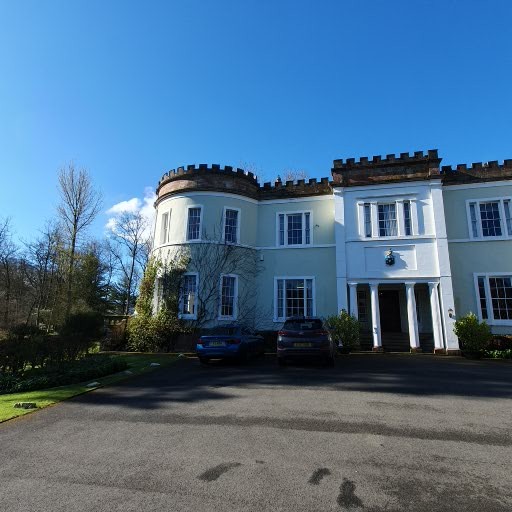
‘Our room’ is #3, the 1st floor turret
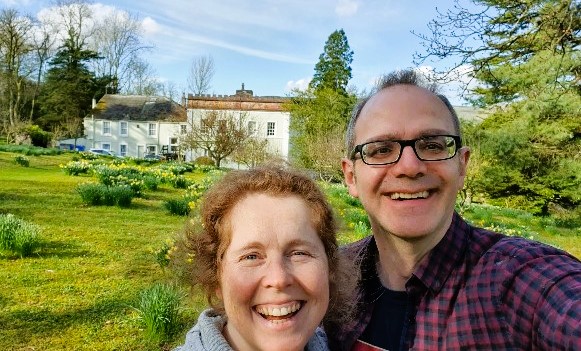
After our first visit we returned twice in 5 years, then again in 2009 for my 40th Birthday. And that was the last time until last week. This might not seem like a lot, but we’ve only been to The Lakes once and not stayed there, and we’ve never been back to the same place anywhere ‘as often’. So when we discovered that the owners, Chef Adrian, Front of House Angela and Restaurant-Bar Manager Stephen were planning to sell the hotel, we were delighted to return, a double celebration of Rachel’s 50th Birthday and our 25th Wedding Anniversary (in August).
Even when we first arrived in 1998, Overwater Hall felt like a place out of time, almost determined not to sway to the latest trends or fashions. In fact, it stands in complete contrast to the identikit phenomenon I discussed in my last post. It is the very antithesis of average. When we returned last week I’m not sure if I could easily pinpoint anything in the public rooms that has changed much since our last stay in 2009. Of course it’s beautifully maintained, but more it felt completely familiar and in an entirely good way. Angela and Stephen’s service is immaculate, quiet, understated, and friendly. Their small team of staff are the same, and it says quite a bit than more than a couple of their team have worked at Overwater for decades.
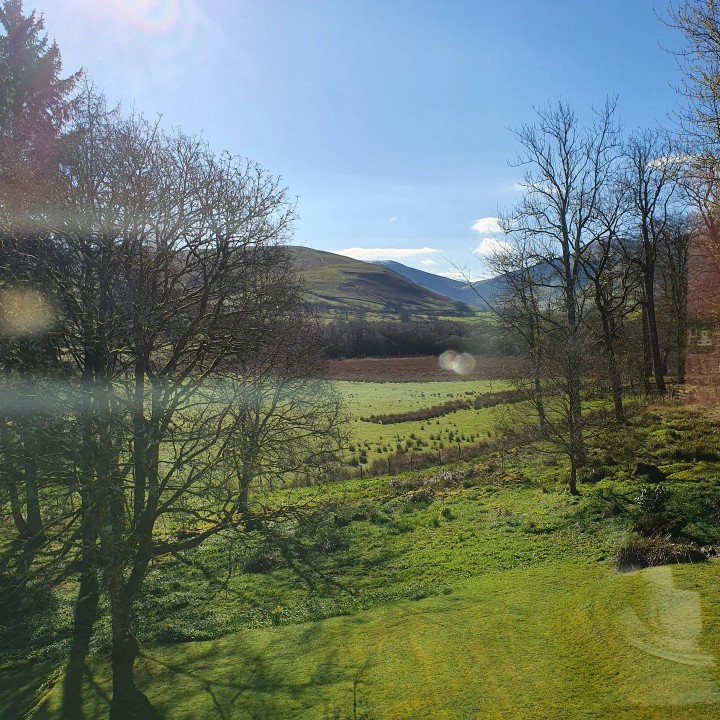
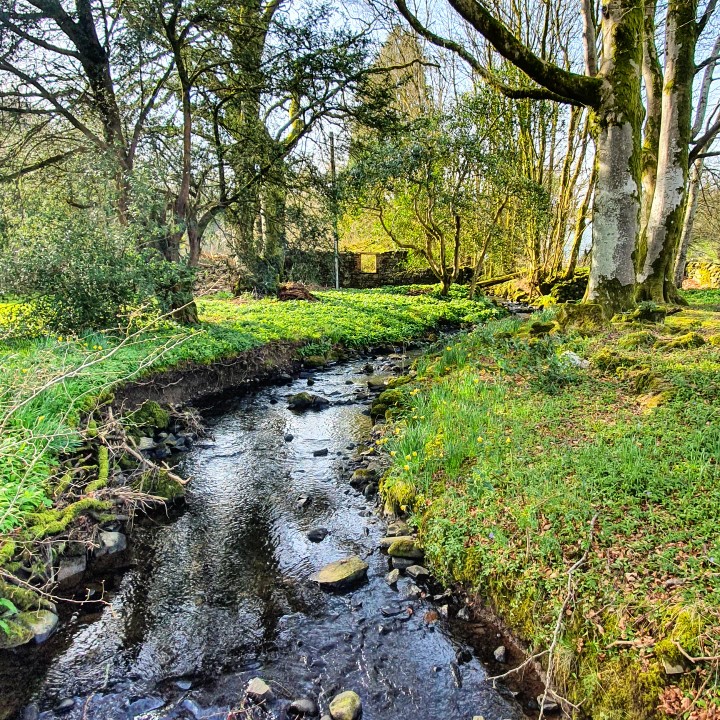
The morning view from our room to the Skiddaw fellsThe stream that flows through the hotel grounds
Overwater is absolutely distinctive. It’s not that easy to get to, at the Northern end of The Lake District, and tucked away in an idyllic setting. There’s no mobile phone reception, and the hotel wifi is ‘basic’, creating a timeless, mindful feeling. We read a lot here, or gaze at the views, listen to the birdsong and (right now) the excited bleating of new lambs. It’s an antidote to the always-on overload of modern life. Perhaps it could be used to teach kids what it was like before the internet and phones and all that.
And then there’s the restaurant, the focus of our initial recommendation. We were absolutely thrilled to discover that, like the wallpaper and service, this too hasn’t changed. The meals we ate at Overwater Hall last week are as good as anything we’ve eaten anywhere. Unfussy but perfect service brings dishes full of imagination, beauty, wit and wonderful, powerful flavours.
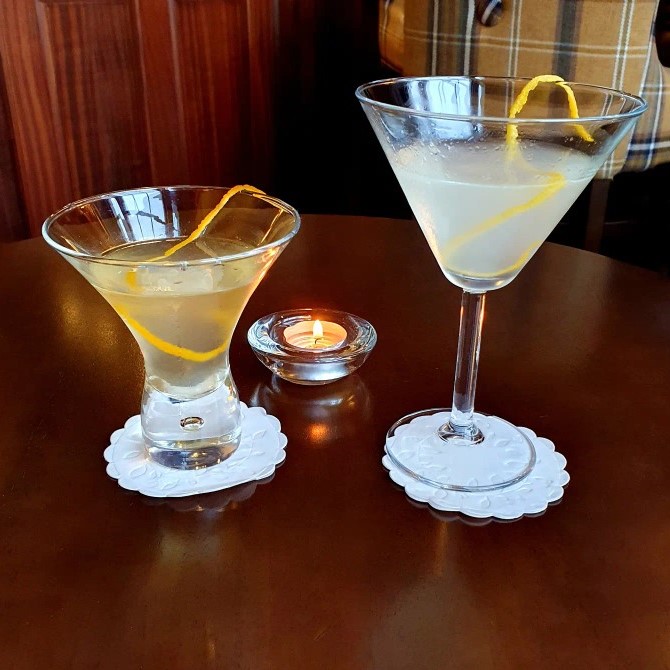
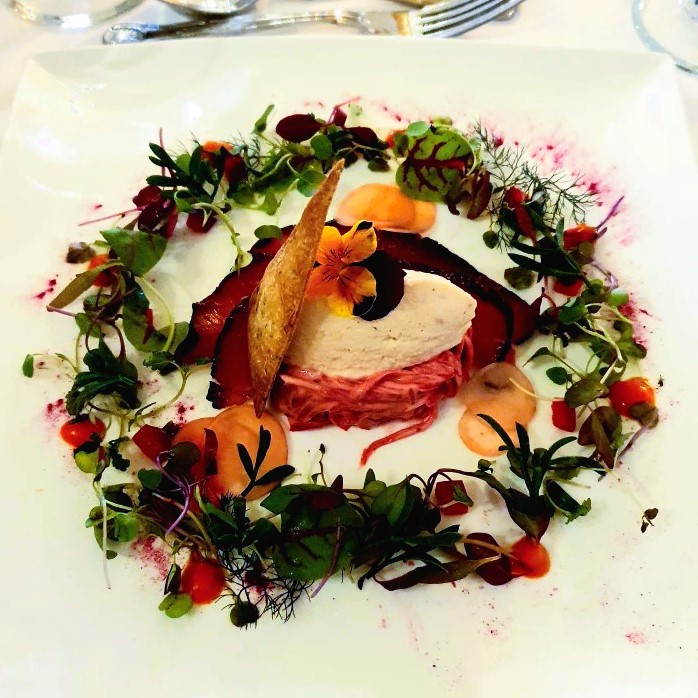
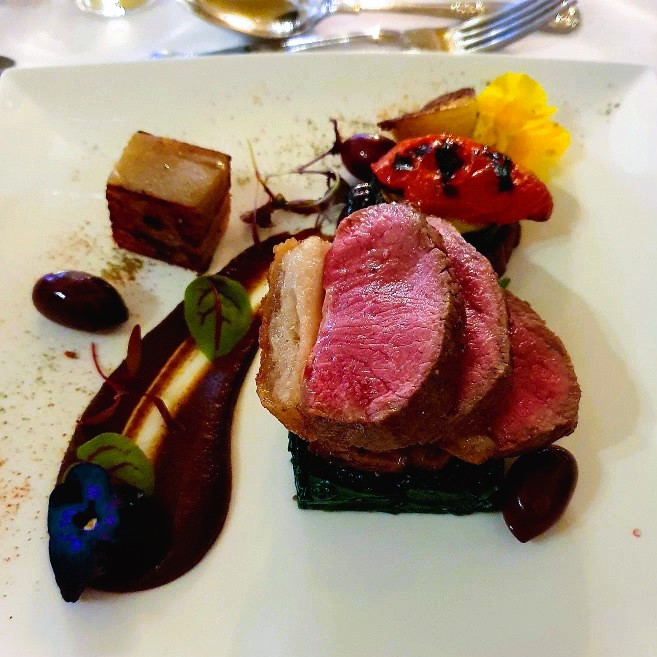
The small cylinders of beef tartare that accompanied our cocktails were melt-in-the-mouth amazing. I could have eaten a whole plateful. Rachel’s salmon starter was a work of art and tasted fantastic. I had quail and smoked pork belly that was breathtakingly good. The lamb fillets were rich and tender, and the strips of fat had a crispy bite to them that was almost like lamb-crackling, while the wild garlic foraged from their grounds was subtle and delicious. My chocolate dessert was fantastic while Rachel had Rhubarb three ways (panna cotta, sorbet, crumble). It’s all exquisite, and frequently moving; it’s a privilege to eat like this.
Dinner at Overwater Hall; as good a meal as I’ve eaten anywhere
But don’t let me neglect breakfast, which is just as good (if less complex!). Ingredients are as locally-sourced as they can be, with black pudding and sausages better than anywhere else I’ve been. This is a place where you definitely don’t need to eat between breakfast and dinner, even after walking up a fell or two and taking a bracing dip in Crummock Water…
As we were approaching the end of our 2nd dinner, and then again at breakfast on our last morning, I felt a wave of melancholy. This will probably be the last time I experience Overwater Hall. While they are currently taking bookings to December, the new prospective owners are engaging with the local planners about their intentions. And while they look impressive (to say the least!), Overwater Hall will not be the same.
To be honest, I Reckon that in many ways it will be objectively ‘better’; more rooms, updated facilities, a pool & luxury spa. It will be sculpted, beautifully designed by top-grade architects. But as Adrian showed us some of the early concepts, it felt ‘calculated’, designed to appeal to a certain clientele (I’m guessing considerably pricier than the current version), with all mod cons. Just like the luxury hotels they’re used to in London or New York or Dubai or, well, anywhere. And that’s fine, of course it is. It’s just not why we love it.
We’re laughing because Rachel’s phone’s selfie setting has a 10-SECOND timer…!?
It will be familiar, but not in its current distinctive way. It probably won’t evoke the very specific and light-hearted joy we felt while walking the wooden boardwalk through the grounds, or from the daffodil clumps that have evolved over decades, or the birds on the feeders, or trying to spot the hotel’s resident red squirrels.
I Reckon we should treasure places like Overwater Hall: they are wholly professional, and absolutely expert at what they do, but they don’t conform to corporate values or functionalism. I will certainly miss it and them when they’re gone, and treasure my memories of a very special and distinctive secret.
Even though he wasn’t the Messiah, but a mixed-up mixed-race naughty boy, I Reckon Brian Cohen was right: we are all individuals, who should think for ourselves, and shouldn’t let anyone tell us what to do. And that includes Latin teachers.
In perhaps a surprising but related way in the middle of the last century, the US Military discovered the flaw of averages (thanks to this brilliant article for that headline). Despite taking 140 measurements of more than 4,000 pilots to better design the cockpit of their fighter planes, they found that, even consolidating data to just 10 metrics, literally no one was in the average range (middle 30%) on all dimensions. Even taking just three dimensions only improved that to 3.5%. They concluded that
If you’ve designed a cockpit to fit the average pilot, you’ve actually designed it to fit no one.
The End of Average, Todd Rose, 2016
This led to a whole new approach to design and engineering, creating adjustable seats, helmets and controls, meaning that each distinctly un-average individual pilot could make their cockpit fit them better. In real terms, this made planes more comfortable and easier to fly, leading to significantly fewer incidents and accidents.
Which might help explain why, after decades of limited technology and increasingly frustrated attention spans, marketers are now pursuing the apparent Marketing Nirvana that Steven Spielberg presented 20 years ago in Minority Report, of entirely personal ads, the mythical audience of one, seeing the right message for the right product at the right time, every time.
Of course we’re not here yet, nor do we want to be. 6 years ago KPMG had already identified a wide spectrum of attitudes towards this in their Creepy or Cool? study. Whatever futurists might think, many of us think otherwise.
And despite this professed desire for brands to get closer to individual customers, offering more personalised experiences with tailored and relevant content, the real world doesn’t seem to be working that way. This has long been obvious in the convergence of cars (especially mainstream Family SUVs) into almost identical shapes and sizes.
As a recent article by Alex Murrell brilliantly illustrates, we have somehow descended into the Age of Average.
…from film to fashion and architecture to advertising, creative fields have become dominated and defined by convention and cliché. Distinctiveness has died. In every field we look at, we find that everything looks the same.
There’s an Airbnb design aesthetic, which is paralleled in contemporary offices and cafés in towns and cities everywhere. Indeed, city skylines and residential developments are more and more similar.
I bet you’ve stayed here, or at least somewhere like it…
And it goes on; media, book covers, even people are looking more and more alike – as Instagram-Face starts to dictate what ‘popular’ people look like, and want to look like for maximum clicks. Always reflecting and jumping on any given bandwagon, marketers have almost relentlessly homogenised their brands in recent years. While this might be more obvious for tech brands, I Reckon it seems at best counter-productive for ‘iconic’ fashion brands… is it really that important to be ‘easy to read online’?
R U OK, Marketing People? The excellent people at BBH Labs talked about this 5 years ago too, lamenting the growing industry trend to devolve brand strategies into self-help manifestos. Fuelled by a dangerous cocktail of Maslow’s Hierarchy of Needs, saturated markets of near-identical products, and the accelerating bandwagons of Diversity & Inclusion, countless brands have hitched a ride on the train of Encouraging Consumers to Be Whomever They Want To Be because, you know, WE SUPPORT YOU.
It’s easier and safer for marketers to let you work out if you like their brand, than it is for the brands to actually express any kind of personality or opinion. Because you might not like it, or someone on TikTok might be triggered, or something.
And then this happens (this is a joke, but only just).
Well I still believe in the doctrine of Distinctive Brand Assets, as preached by most of the Wise Marketing Types I like to pay attention to. Standing out so you can be more easily recognised and remembered, so associations are formed between brand names and logos and design and products. Which is why, for the longest time, I was a massive admirer of Audi’s marketing. From their amazing depiction of BMW-drivers as arrogant w**kers to the wonderful insight of “I’m a great driver, it’s everyone else that are the problem”, their ads had been witty and compelling, all based around the very German Vorsprung durch Technik. Now, Future is an Attitude, whatever that means.
Average in, Average out. But there’s a snag in trying to stand out or be distinctive, because algorithms reward popularity, not plucky outliers. Popular-but-Inoffensive trumps Interesting-but-Quirky. So brands start to exist in echo chambers of their own making. They encourage their ‘audiences’ to express themselves, but for the purposes of our primitive Minority Report targeting they do that less in the places they go, the clothes they wear, the people they’re seen with or the cars they drive, but in their Likes and Shares. Brands suck in that information and chase it, anxious to reflect whatever it is they think that we like today. But they only get a fraction of what we like, as if the US Military had measured pilots’ head circumference but not their leg length.
The machine-learning AIs that control what we see, read and hear can only recognise that very partial incomplete version of self-expression and show it back to us, but they base their knowledge on everything they see, read and hear. And as Alex Murrell and others have made very clear, the places, clothes, people and cars they can see, read and hear about are converging towards homogeneity.
So that’s what we’ll see, and like, and they will show it back to us, and hope we like it, and them. And when we do, because we will eventually, they will congratulate themselves that they have connected with us, and we have engaged with them. But really, if different brands look more and more like each other, how will we know which one we liked?
I was convinced that I’d used this R.E.M. lyric in a previous title: I’ve written close to 320 posts over nearly 14 years and I couldn’t believe this hadn’t come up. I mean, if you’ve read more than a handful you’ll know there’s plenty of existential angst and righteous-frustration with the world, as well as (futile? misguided?) attempts to reconcile the personal and the global.
Anyway, as in many things it turns out I was mistaken, and as the trigger for this evoked the lyric so immediately, I’m almost relieved I can use it. It was during a morning take-off session with the lovely people at FLOWN (yes, them again). The prompt for our morning journalling exercise was
“what do you struggle to accept, that you have no control over?”
Well, let me count the ways…
This came after a a double-rarity in my world, of two dreams that I actually remembered, on consecutive days. I probably remember a dream no more often than every few years, and when I do they’re usually reflective of an anxious state of mind or something specific. These both fitted that description.
In the first I was in some non-descript near-future (I think I felt older than I am, but not too much), and there was just evidence of the world going to pot; news reports about crop failures, flooding, natural disasters, social media being even worse than now, political strife etc. Quite a bit like Christopher Nolan’s film Interstellar. It was amazingly simple and on-the-nose, almost nothing out of the ordinary or surreal at all.
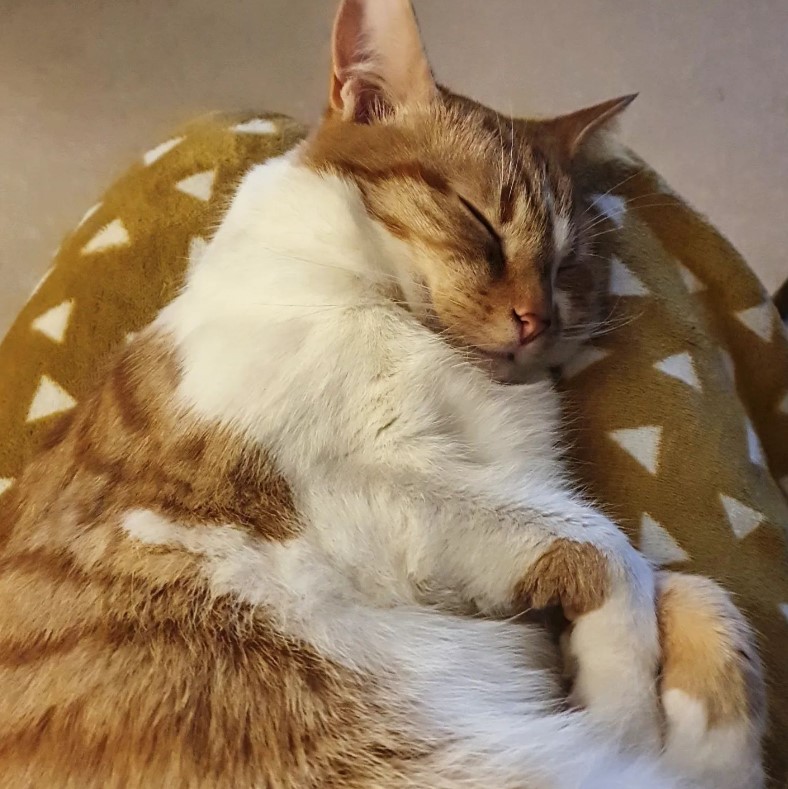
On the other hand, the second one was a conversation between me and our cat, Todd. I don’t recall what I was saying, but he was reassuring me. He often ‘talks’ to us in squeaky, expressive miaows – seeking attention, food, someone to attack (or all three), and his mouth was moving like that, but there was a human voice talking quite calmly, encouraging me not to worry, that things will be OK. I’d love to say he had the voice of Tom Hanks, but that would be an embellishment too far. Still, if you need someone to reassure you that the world is going to be OK, you could do worse than Todd, right?
So while my morning Flock were thinking about what challenges us, we also considered a short poem…
Clearing – Martha Postlethwaite
Do not try to save the whole world or do anything grandiose. Instead, create a clearing in the dense forest of your life and wait there patiently, until the song that is your life falls into your own cupped hands and you recognize and greet it. Only then will you know how to give yourself to this world so worthy of rescue.
This is about acceptance, the grace to accept that world may well be going to Hell in a Handcart, but it’s not my responsibility to stop it. Sure we can all do our part, because every little helps…
what is an ocean if not a multitude of drops?
David Mitchell, Cloud Atlas
…but we have to work on ourselves first, how best we can contribute, and on what scale we can. I Reckon that I mostly struggle to accept the fact that I don’t have any control over stuff that matters to me, like the moral qualities of politicians, or so-called journalists who write sh*t and get paid for it. It’s so important to create pace in rhe dense forests of our lives where we can be quiet and calm. And then make a difference close to home, for ourselves, our family and friends, our community. And if at some point the song that is our life reveals itself to be greater, broader, deeper than that, so be it.
I’ve often wondered about our cats and what they are thinking. I’m 98% certain that most of the time they are entirely in the moment, their immediate surroundings. Where am I? What’s the basic state of things? What can I do to get the most of that? What can I do to change it? What do I need right now? Yes, pretty self-centred, but absolutely not entirely. Todd (and Whiskers before him) makes a significant and postitive difference to my / our mental health, and I Reckon he knows it. He knows how much we both enjoy him sleeping on my lap, or playing like a lunatic with his toys.
I can’t always carry the weight of the world, and he definitely relieves my burden.
So, in my short series of Reckons about Beginnings and Endings and Things having an order, it’s time to have a look at things that don’t necessarily do that.
The ‘cut-up‘ literary technique is said to originate in the early 20th century, and was perhaps more publicly ‘invented’ by writer William S. Burroughs and writer/artist Brion Gysin, by which they assembled random fragments of text, often from multiple sources including newspapers, in order to create a new text. David Bowie is perhaps the most famous proponent of the technique, as he explains here, but Kurt Cobain and Thom Yorke are also known to have experimented with it. In this clip Bowie talks about working to create a software tool (the Verbasizer!?) that he used to input materials to create many different options and outputs. Perhaps in the same way Bowie famously predicted the upsides and downsides of the internet in 1999, I Reckon this is an early foreshadow towards AI writing tools like ChatGPT, except without the intelligence to create its own lyrics…
I Reckon Quentin Tarantino’s best film is probably Pulp Fiction, and it was certainly pretty revolutionary at the time, in that its interwoven stories among various strands of the (criminal) underbelly of Greater Los Angeles in deliberately fractured, jumping backwards and forwards in time, so that it actually ‘ends’ where it ‘starts’ in terms of the assembled scenes and sequences. But this is far from the final scene, and it’s not the chronological start either. It must be pretty great to see this film for the first time to have the WTF moments as you realise what Tarantino’s script is doing and how it’s manipulating the audience’s understanding.
Kaleidoscope is a 2023 Original TV Series from Netflix that tells the story of a heist and the characters involved over a period of more than 25 years. Its concept is pretty intriguing in that each episode has a colour rather than a number and viewers are encouraged to watch the show in any order (although Netflix recommends you watch the actual heist last). Netflix randomises which episodes you get to watch next, so even with their recommended constraint about the final episode, the previous seven could be watched in any one of over 5,000 orders. This nifty use of technology evidently requires a different approach to storytelling, in that end-of-episode cliffhangers won’t immediately be resolved, the plot cannot rely on the audience knowing everything about a character before a new twist or detail is revealed, and so on.
Each episode does have a place in time relative to the main event of the actual heist…
Violet (24 years before the heist)
Green (7 years before)
Yellow (6 weeks before)
Orange (3 weeks before)
Blue (5 days before)
White (the heist)
Red (the morning after)
Pink (6 months after)
Non-Spoiler Comments… When I peruse the reviews on Letterboxd, what strikes me is that they seem remarkably similar to any other thing that get an overall 3*** rating on the site. It’s good, but not great. Some of the reviews mention characters or storytelling, quite a few mention the ‘gimmick’ of the random / self-selected episode order, but not everyone, and it’s clearly not the main thing about it.
We saw the episodes as follows: GREEN – YELLOW – BLUE – VIOLET – RED – PINK – ORANGE – WHITE (saved for the end)
Ultimately, I Reckon Kaledioscope is … fine, but not much more than that. Jumping around the timeline offers up some nice reveals and twists, especially smaller details like why a pink cuddly toy might matter, or how someone got that limp… but these could and would have happened in any non-linear storytelling that was structured and shared by every viewer. The producers and writers here have given themselves some significant constraints, and to be fair to them they have committed to them pretty well. But there are reasons why structured narratives have worked for so long, in that the creators can control the story, and they’re usually pretty good at doing that. I like books or series or films where they can surprise me, where something can happen that compels me to find out more, immediately.
That didn’t really happen in Kaleidoscope, because they cannot know in any given episode what people have already seen, so the reveals or twists are often more generic tropes of the genre (who’s the potential mole in the gang, what happened to ____?) and they have to use those smaller details, allowing viewers to piece things together for themselves. Again, this is often quite rewarding for the viewer, but they have to telegraph things more obviously, so that whether we see the reveal or the setup first, we can make the link between two shots possibly hours apart in the drama. So the camera dwells, meaningfully, on something apparently not meaningful, except now we know it is, and it’s distracting us; maybe not a lot, but more than not at all. And this is all because of the decisions and constraints they have set for themselves.
I mostly liked the order we watched because GREEN & YELLOW are both nice set-ups for most of the characters and for the heist itself, so it was good to get them first, before jumping around a bit more. I Reckon it’s also a good idea to have RED and PINK later on, closer to the end. For me this is partly because the ultimate finale is pretty underwhelming, so if I’d seen PINK first I’m not sure I would have cared to watch all the details of how they got there. It is a good idea to leave WHITE until last, as they do knit various plot strands together pretty well, and as it’s the heist it is a pretty dramatic episode.
The series, as seems to be increasingly common, has a pretty A-List soundtrack, but in this case they use it as a battering ram to remind / inform us what might be going on. This is especially egregious towards the end, as Judy and Bob (separately) are listening to Lynrd Skynrd’s ‘Freebird’ (even though it predates both of them by about 10 years) and the same lines ‘Lord, I can’t change…’ come on repeatedly. All right, we get the point. This starts off as noticeable, and by the end (especially the PINK aftermath/conclusion) it’s really annoying. With the reveals thing, they created a rod for their own back; these music choices are, I Reckon, just badly done.
So, after all that, I don’t Reckon Kaleidoscope got close to being the vanguard for a new format of TV series and viewing. Stories do need a beginning, middle and end. Yes it’s possible to muck around with things; bards and elders and writers and oral histories and stand-up comedians have been doing that since the dawn of civilisation. This ‘choice’ doesn’t, IMHO, make a big enough difference, even if the creators had executed their story better. If you have 8 hours to spare to watch something on Netflix, I would heartily recommend the amazing and epic Indian film RRR, the very tough but terrific All Quiet on the Western Front, and the wonderful Marriage Story.
And now, if anyone cares for some more details and reactions to specific episodes, or the way we felt in going through Kaleidoscope, please do read on, but consider this Fair Warning that I will talk about the plot.
GREEN (7 years before the heist) Ahhh, quite a Shawshank-y vibe going on. Is he deliberately trying to channel Morgan Freeman in that voiceover? Hmmm – don’t trust that Judy; she seems way out of Stan’s league. I mean, his name isn’t in her league, let alone his nerdish curls… surely she’s playing him. And who’s BOB? I mean, he’s an obvious dickhead who will probably die badly by being either irretrievably macho or stupid later on. But I Reckon he’s much more Judy’s type… OOH! Good escape sequence… who’s the estranged daughter – why are they estranged, and hey, isn’t that Rufus Sewell. He must be a baddy, that’s his Thing now… Overall, a decent start – I will watch on!
YELLOW (6 weeks before the heist) BIG time jump, although [checks] this is actually the next episode. OK, so this is about getting the team together. Hannah and Leo seem ‘no-longer-estranged’… she’s the insider on the job then? So what DID Roger Salas do? God, but Bob is still a dick. And I knew he was Judy’s type… Oh – GOOD LINE about ‘the Die Hard thing’… So far, still OK. The Die Hard line definitely lifted it a little…
BLUE (5 days before the heist) Ahhh, now we’re getting the How-We’re-Going-to-Break-Into-The-Impregnable-Vault. Sorry, but George Clooney, Brad Pitt and Steven Soderbergh did this MUCH better in Ocean’s 11, but kudos for ttrying… Clearly they’re trying to make us wonder who is double-crossing the rest, or if anyone ISN’T doing that. Whatever. I like RJ, but I have my worries something bad will happen to him. Beginning to settle into this, ho hum.
VIOLET (25 years before the heist) WHAT the Actual F**K is going on with that CGI and hair to make Leo look younger. Except Young Leo is apparently Ray. Of course Roger Salas starts out as a lowlife thief called GRAHAM, with a bit of ambition… Ooh – setting up a fear of small spaces, and I AM CERTAIN (not just a Reckon) that Where Are You Smart / Brave (etc) thing will come back at the end somewhere. They’ve been watching Gallipoli or, more likely, Face/Off… But again, WTAF is that hair and CGI…? The anti-aging-CGI cream is SO distracting, even though the story got me back…
RED (the morning after the heist) GOOD START – half the gang on a boat (that wasn’t in the exposition planning?!) and they’re NOT happy. What went wrong? Where are Bob, and Ava, and NOOOOOOO – where’s RJ? Hang on – why did Judy leave behind the bag with all the passports and documents in? That’s just STUPID. OH – HUGE PLOT ALERT – the bloody bonds aren’t ‘gone’, they’re in those FedEx delivery boxes. What uber-high-tech security company FedExes a trolley load of boxes anyway? That should be a MASSIVE red flag right there… Perhaps my favourite – I like that it went wrong. I like this is only 35 minutes. I like that there are loads of questions left.
PINK (6 months after the heist) Yikes – has Leo had a stroke or something, he’s really not well. IS that how Parkinsons works? Almost no change in symptoms for 7 years then a massive collapse in a few months? Or has he had a stroke? Are they going to explain this? Bob’s alive?! Well, of course he is, but how exactly? Although he’s quite fun with the phone and almost no voice. So in the end, nearly everyone dies. Ho hum, not sure that’s especially rewarding? Was that RJ taking out Leo? Surely we should know who it was – I’m guessing we’ll get to see the t-shirted assassin in the heist or an earlier episode?Where is RJ? Maybe it wasn’t him, he must be dead… Bob goes down in a blaze of not-glory, Judy runs off with whatever money there is, and bloody Stan is left eating his f***ing lengua tacos like a sad sap. He’ll probably hand himself in accidentally… even the FBI lady gets taken out (ouch!). And Hannah gives back the money to the Nazis after all, while Roger sits in prison to get out on parole in a few years. Not sure this is the ending I was looking for – did I miss something though? How is Hannah affording her gorgeous clifftop mansion? She must have creamed a few bearer bonds off the top as a commission for the Triplets? Is that it? All the open questions have been closed in a bad way. I actually felt for Bob, which says something.
ORANGE (3 weeks before the heist) Ooh – quite like the focus on Nazan the FBI lady, and her addiction history. And her cuddly toy that got tidied off her desk in the PINK episode. Ouch, that hurts. Not so sure about the unecessary love interest with her younger agent – as I didn’t even get a hint of that from the later scenes with them. Hmmm – that’s nonsense. Ahhh – it WAS Ava who informed the FBI… but I thought she was a Good One – she stays with Leo to the end…? Wish I’d seen this before the aftermath.
WHITE (the heist) Nicely done, like the idea with the bees… NOOOOO RJ! I knew Judy was a wrong ‘un from the start. OOH but she did shoot Bob, which is understandable after she’s put up with him for at least 7 years. I assume the sex was great, but that is a Very Long Game she was playing… LIKED that Ava’s ‘cooperation’ with FBI included sending them on a wild goose chase, and left them Roger Salas’ business card with a hint… I do not believe that Bob (a) knows the word ‘tracheotomy’, (b) has the first idea how to perform one, (c) would be capable of even standing up having been choked, windpipe crushed, and being unconscious, let alone performing a tracheotomy ON HIMSELF, before almost instantly running off into the night…!? Hannah and Liz might be very smart with dextrous young-people hands, but they did NOT have time to switch out the bonds from those boxes, even just a few on each box, in the time they had. Thise boxes were stacked several layers deep, and were heavy (noone seemed to carry more than two at a time) – that’s some serious lifting there…
So there it is; a lot of planning, in the writers’ room and in the heist. It was fun along the way and pretty entertaining, but I don’t think I’ll ever consider rewatching it, or probably not anything like it. I like to be in the hands of the story-tellers, let them tell me what they want, give me hints and clues, throw in ambiguity for me to interpret, but I like the shocks and surprises, the twists and reveals, and I Reckon the option to let people choose the order in which things happen weakens those moments.
Having a storyteller in control makes it easier for us humans to listen, pay attention and understand, it makes us more likely to engage and get what you’re saying. Have a story and tell it your way. Start where you want to, but make it make sense, and when you get to the end, stop.
It’s a truth universally acknowledged that every Dad I know has at some point hoped, wished or actively pushed their music tastes onto their children. I’m thrilled that Jamie embraced ELO and Eleanor has gone for The Arctic Monkeys in such a way. So they haven’t gone beyond polite tolerance of my Radiohead obsession, but they’re still young: plenty of time for worldly angst and hopelessness to set in…!
It’s a treat for me every day that I get to take Ella to 6th Form, as it means I get time with her, and I let her take control of the in-car music. This has seen me evolve from slightly at-a-distance respect to proper admiration and appreciation for Taylor Swift, and especially her Middle Eights! I’ve also learned about artists (mostly younger female singer-songwriters) that my Spotify algorithm might never have suggested, given my middle-aged-middle-class-white-English-boy tastes; beabadoobee, dodie, faye webster, maya hawke (and wet leg, although she may have got them from Radio 1?).
But my favourite discovery by some distance from Eleanor has been Lizzy McAlpine. Beautifully arranged songs, hugely intimate and evocative lyrics that talk of young love, heartbreak, rage, impotence, insecurity; all the things I would have latched onto in a heartbeat when I was 17. I Reckon her voice is tremendous, and the arrangements and variety in her songs are truly special.
And to continue the theme from my recent posts, another favourite thing I like about her is that her most recent album, five seconds flat, is a deliberately-structured sequence of songs with a beginning, middle and end. But don’t just take my word for it; Elle Muller, student journalist at Dartmouth College, says it very clearly
The album follows a very cohesive narrative, sculpted by the order and structure of the album. Upon release, McAlpine wrote on Instagram, “i really put a lot of work into making sure that the track list was in the right order and the story that it told was cohesive so i would urge you to listen through the first time in order.” “five seconds flat” is a narrative masterpiece, artfully telling a story of love and loss with emotional songs that leave the listeners aching.
I love pretty much all of this, but especially the opening track doomsday which talks about the end of a relationship as if she’s planning her own funeral; all my ghosts, which invokes the spirits of past relationships haunting her attempts at new ones; reckless driving, which made me gasp and laugh out loud when I first heard it, and firearm, a gentle and then definitely-not-gentle song to an ex-partner…
And on top of the songs, and the storytelling and the heartbreak and the humour, she also makes some beautiful videos to accompany and dramatise her music. In fact, she turned several of these into a 29-minute film, again with the tracks in the right order, to bring to life the emotions from the songs, not least the use of ‘skeleton’ make up on more than one character to illustrate their metaphorical death during or after a relationship. It’s clever stuff wonderfully realised, and in a way that makes me feel very old, she’s barely 23 years old. When I was her age I was about to graduate from university with a great degree but no job and not much immediate hope of getting one (we were in a recession; plus ça change…!).
I have to say I’m all in for Lizzie McAlpine – alongside her two albums and various smaller collections of songs released mostly since the COVID pandemics struck – she has collaborated with a number of other artists and features guest vocalists on her own music. Special mention here goes to her excellent versions of ABBA’s Dancing Queen and The Bee Gees’ Stayin’ Alive, both with the group of musicians known as Scary Pockets.
I’m just gutted that for some unknown reason I delayed buying tickets for her shows in London this coming June, as they’ve now sold out. Eleanor and her friend are pretty pissed too, but too polite to say anything. I (hope and) Reckon she’ll be back, because I Reckon Lizzy McAlpine is the Real Deal.







 What I Reckon